Why We Scrapbook: The Stories Only You Can Tell
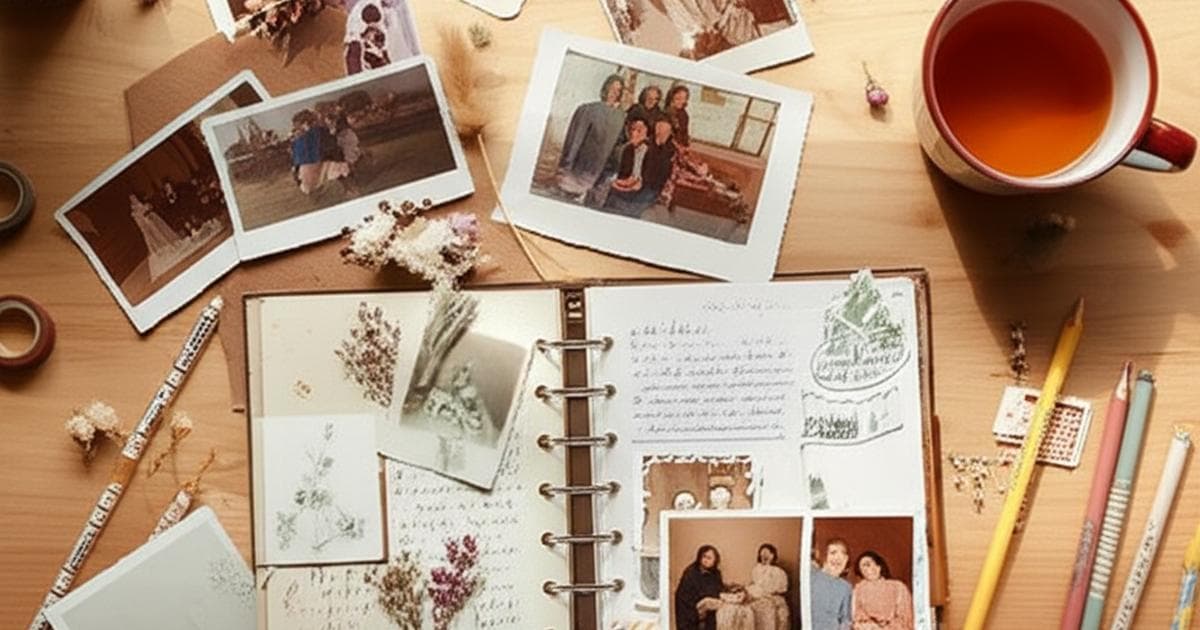
Ask someone why they scrapbook, and you'll get a hundred different answers. Some say it started after a baby was born. Others picked it up after a parent died, suddenly desperate to hold onto anything that remained. A few just wanted to do something with the 4,000 photos sitting untouched on their phone.
But if you listen past the first answer, you almost always hear the same thing underneath: I didn't want to forget.
That's the real reason. Not the pretty paper, not the layouts, not the hashtags. It's the fear that one day you'll struggle to remember exactly how your daughter laughed at age three, or what your grandmother's handwriting looked like, or the way a particular summer felt. Scrapbooking is how we fight back against that.
Stories Have Weight
Here's something that gets said a lot: a photo is worth a thousand words. But a photo without context? It's worth maybe ten.
I've looked through boxes of old family photos and found myself completely stumped. Who are these people? Where was this taken? Is that a wedding or a Sunday lunch? The images exist but the story is gone, because no one wrote it down.
That's what journaling in your scrapbook actually does — it turns a frozen moment into something alive. It's not just "here's a photo of us at the beach." It's "this was the day we almost didn't go because it looked like rain, and then the sun came out, and your dad found a starfish, and we stayed until it got dark and ate fish and chips in the car on the way home."
That's a story. That's the thing your grandchildren will actually want to read.
In MyScrapbook Studio, the text tool is built with this in mind. You can add journaling directly onto a page — free-form, layered over photos, tucked into a corner — without it looking like an afterthought. Different fonts, sizes, and placements let you make the words part of the design rather than a footnote. The story and the image work together instead of competing.
You Don't Have to Be a Writer
This is the part that stops a lot of people. They open a blank page and freeze, convinced that whatever they write won't be good enough.
It doesn't need to be good. It needs to be honest.
Write the way you talk. Use the words your family actually uses. If your kids have a nickname for something ridiculous, use that. If you always called Sunday dinners "the Sunday situation," write that. Those specific, slightly odd details are what make a memory feel real when you read it back ten years later.
Some prompts that actually help:
- What were you worried about that day that turned out fine?
- What smelled or sounded like that moment?
- What would you want your child to know about this time?
- What almost didn't happen?
Start with one of those and write three sentences. That's enough. You can always go back and add more later — MyScrapbook Studio saves your work as you go, so nothing is ever lost, and nothing is ever final until you want it to be.
The Community Part Nobody Talks About Enough
Scrapbooking has always been a community activity. Before everything moved online, people had crops — gatherings in someone's living room or a church hall, tables covered in supplies, hours spent side by side working on pages and talking.
The talking was the point. Stories shared over scissors and adhesive. Someone would describe the photo they were working with, and someone else would say "oh, I have one like that from when my mum was young." And suddenly you'd be three hours deep in family history and completely forget you were supposed to be finishing a layout.
That connection still happens. It just looks different now.
Online scrapbooking communities share layouts, swap ideas, and cheer each other on in a way that felt impossible to replicate digitally for a long time. But it works. Some of the most generous creative feedback I've seen has come from people who've never met in person and live on opposite sides of the world, brought together by a shared interest in keeping their families' stories alive.
What makes it work is specificity. Showing a page you're proud of and saying "I used my daughter's actual words from a voice message she left me" is a completely different thing than posting a generic layout. People respond to the story behind the page.
Starting When You Have Nothing
Maybe you're reading this because you want to start but feel behind. Years of unorganized photos, no system, no idea where to begin.
Start with one photo.
Just one. Open MyScrapbook Studio, drop a photo onto a canvas, and write three sentences about it. Where you were, who was there, one thing you remember about that day. That's your first page. That's enough to start.
The photos don't have to be in order. You don't have to start from the beginning. Memory doesn't work chronologically anyway — it works by association. A song, a smell, a photo that leads you somewhere unexpected.
Some people build their scrapbooks backwards, starting with recent memories and working their way toward older ones. Others do themed collections — all the birthday photos, all the holidays, all the ordinary Tuesdays that somehow turned meaningful. Neither approach is wrong.
MyScrapbook Studio's drag-and-drop canvas means you can rearrange, resize, and rethink a layout without starting over. If something isn't working, you move it. The flexibility is the whole point.
What Gets Preserved When You Do This
Here's the thing about memory keeping that takes a while to understand: you're not just making something for yourself.
The pages you create now become primary sources. First-hand accounts. The actual record of what your family's life looked and felt like during this particular slice of time.
Your grandchildren won't find your Instagram grid. They probably won't be able to access most of the apps you use today. But a well-made scrapbook — digital files backed up properly, or pages printed and kept somewhere safe — can survive decades.
The stories you write, the handwriting you show, the context you provide for photos that would otherwise be mysterious: that's the stuff that matters. That's what separates a preserved memory from a lost one.
Start with one photo. Write three sentences. See what happens.
The community will be there when you want to share it.
Keep Reading
- Why We Scrapbook: Community Stories That Keep Memories Alive
- The Gift of Looking Back: Why Your Memories Deserve More
Ready to start your first page? MyScrapbook Studio is free to try — no design experience required. Join the waitlist and be among the first to access all features when we launch.